
January 2026: Build a better machine
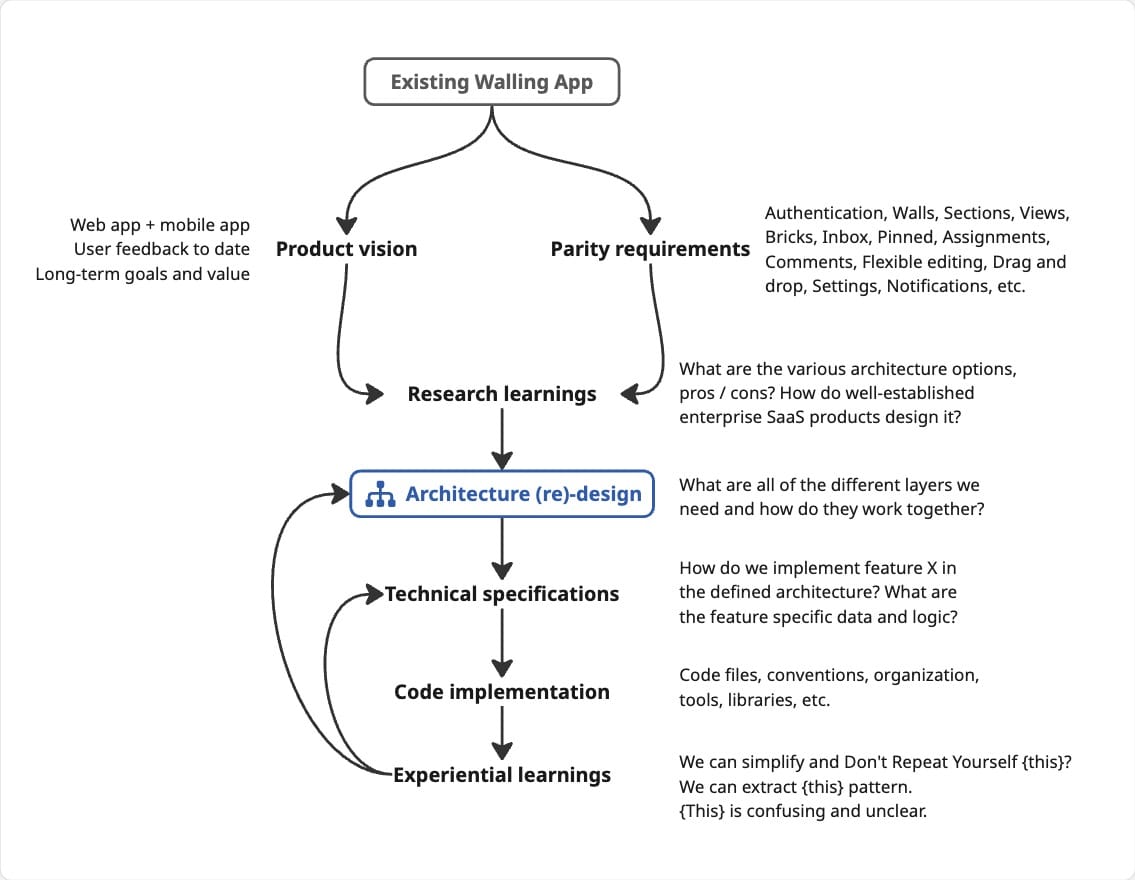
January was a different kind of month for us.
Instead of shipping visible new features, we took a step back to make sure we’re building Walling in the right way, again — for our users, and for the long term. We think of this as Act II of the rebuild.
Act I — Experiment and Learn (May–December 2025)
Move fast, build real features, test the stack, and uncover Walling-specific requirements.
Act II — Decide and Lock In (We’re here)
Apply those learnings, align with long-term goals (like mobile), and lock in the patterns that matter.
Act III — Accelerate (Coming next)
Ship faster with confidence, higher quality, and less friction — because the foundation is solid.
Read below to see how recent work on Inbox and Tasks led to new thinking about the mobile app, how that converged with many learnings from Act I, and how we’re making sure the next phase of progress accelerates instead of compounding complexity.
Why mobile became non-negotiable
From the beginning, we intentionally focused on the web app. Our goal was to move fast, reduce cognitive load as a small team, and avoid fragmenting effort across too many platforms. We believed a strong web experience — extended through a progressive web app — would cover most needs early on.
But as we built task management in December and Inbox foundations in November, a pattern became impossible to ignore.
Ideas don’t always arrive when you’re sitting at a desk. In fact, they more often show up while you’re scrolling, walking, listening, watching, or reacting — almost always on a phone.
The more we thought about how people actually capture inspiration today, the clearer it became: a meaningful part of Walling’s value lives on mobile.
That realization pushed us to zoom out and rethink the entire Walling experience, and our approach.
Different form factors, different jobs
Instead of treating mobile as a smaller version of the web app, we started asking a more important question:
What can Walling do best on mobile versus on the web?
- Mobile is about capture, quick review, lightweight organization, and staying connected to your ideas wherever you are.
- Web is about focus, structure, depth, and sustained thinking.
Once we framed it this way, it became clear that mobile deserved a more specialized role — and a UX designed specifically around its context.
But that raised another hard question.
How do we support both — without overwhelming a small team?
Supporting both a web app and a mobile app can easily double complexity. That’s exactly what we want to avoid.
So we took a hard look at our architecture:
Web App + API + the early SDK work + our backend systems
The conclusion was clear.
To move forward sustainably, we needed to centralize more logic and services that were living inside the web app — and expose them through clean, shared interfaces that any client could use.
This way:
- We build core logic once
- Web and mobile consume it consistently
- Each app focuses on UI, UX, and client-specific behavior
- Cognitive load stays manageable as we scale
Locking in our v2 architecture
January became about committing to that direction.
Earlier work in the web app was intentionally exploratory. We moved fast to learn, and we learned a lot — about real requirements, edge cases, architectural boundaries, and what not to do.
That clarity gave us confidence in the direction we needed to go.
So this month was focused on:
- Locking down the v2 architecture that supports web and mobile
- Writing documentation to make the system understandable and repeatable
- Beginning the migration of shared services out of the web app and into central libraries
- Scaffolding the mobile app so we can validate these foundations across both clients
We’re also actively learning and adopting new ways of working that improve development velocity, and ensure consistency and quality — changes that will compound over time.
The tension we’re feeling
We want to be honest here.
This phase is stressful.
We know users are waiting. We know progress can feel slow from the outside. And rewrites are especially hard when people already have expectations for functionality.
But we also know exactly what parity we need to reach. We have the blueprint. We have feedback. And we’re confident that this path — while harder now — sets us up to move faster and with higher quality going forward.
January’s progress is real — it’s just harder to see.
What we accomplished
- A locked-in v2 architecture designed for web and mobile
- A scaffolded mobile app to validate shared foundations
- Active refactoring and migration of core services
- New workflows and patterns that increase long-term velocity
A glimpse of the new Walling
We’ve included a short video walkthrough of the new app so you can see how things are coming together. While you'll see there's still some work to do, you'll also see how we're achieving parity and modernization of the app.
Looking ahead to February
Next month, our focus is straightforward:
- Continue the refactor and migration
- Finish consolidating shared services
- Shift from foundation-building into acceleration
- Move decisively toward a beta release
Thank you for sticking with us through this quieter — but crucial — phase. We’re building something meant to last, and we’re excited about what comes next.
— The Walling Team